
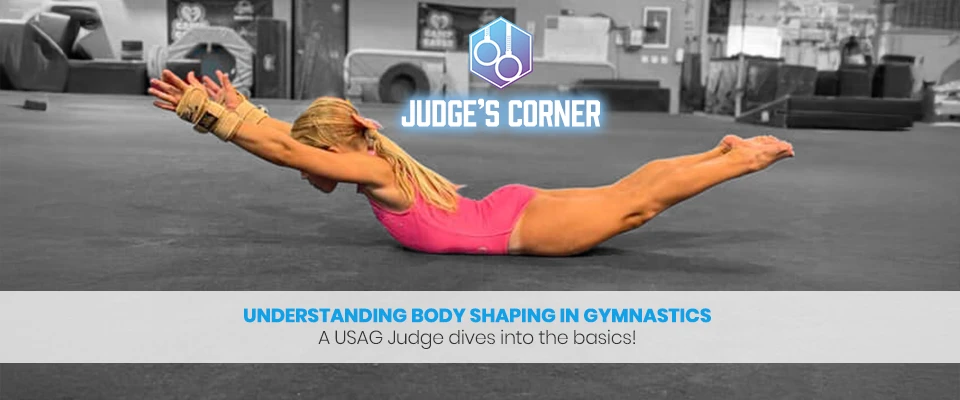
The one where a USAG Judge – with help from meetcritique Ambassador, Violet (and her mom!) – digs deep on the basics. Piked body position, arched body, insufficient hollow?? What does it all mean?
Introduction
Gymnastics is a sport defined by precision, strength, and artistry. A fundamental aspect of the discipline involves mastering various body shapes and positions, which are essential for executing skills safely and efficiently. These shapes are used across all apparatuses and form the foundation for both basic and advanced movements. Many deductions you will find in your meetcritique will call out an incorrect body position for that skill. Each body shape has a time when it should be used and when it shouldn’t be used throughout a skill. Some skills may utilize many different body shapes.
Why Body Shapes Matter in Gymnastics
Correct body shapes help gymnasts maintain balance, generate power, and reduce the risk of injury. You will hear coaches emphasizing these positions from the very first class. Conditioning often focuses on using these body shapes to build muscle memory and technique that support complex skills later on.
Hollow
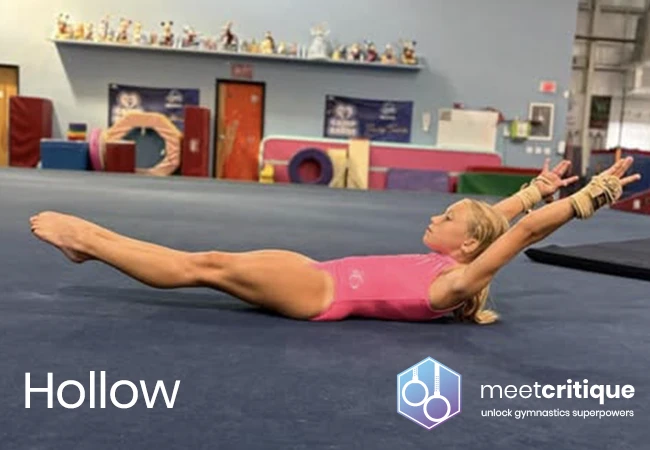
One of the most used shapes, but often difficult to master, is the hollow body. Here, the gymnast contracts the core and rounds the shoulders and glute muscles by squeezing to create a gentle curve. The head should stay between the arms. This position strengthens the midsection and is vital for control during swings and holds.
Appropriate uses: Tap swings or giant swings on bars, the snap down of a roundoff or back handspring, pre and post flight of a front handspring vault
Inappropriate uses: Arched based skill such as front or back walkovers

Tight Arch
In the tight arch position, the gymnast creates a controlled, slight backward curve in the torso, with hips pushed forward and shoulders tilting back. The head stays between the arms. It is the opposite of the hollow body. The back should stay tight and engaged, not loose and floppy. Often, the gymnast will quickly change from a tight arch to a hollow body (or vice versa) to create power.
Appropriate uses: The very bottom of a tap swings on bars, reaching back to the vault on a Yurchenko style vault, the jumping back of a back handspring
Inappropriate uses: Any type of handstand, casts on bars

Layout or straight body
A straight body position, sometimes called the layout shape, is characterized by a fully extended body, with arms by the ears and legs together and straight. This position demands core strength and is utilized in skills where maintaining a rigid form is crucial for proper rotation and landing. It can be confusing because at times either a hollow body or a straight body is appropriate.
Appropriate uses: All handstands, layout style skills including twists, straight jumps
Inappropriate uses: Swings or giants on bars, the snap down of a roundoff or back handspring

Piked
In the pike shape, the gymnast keeps the legs straight and together while bending at the hips, forming an “L” shape with the body. An ideal pike has at least a 90 degree bend. Hands may reach toward the feet or shins or straight up over the head. A partial pike – where there is a small bend at the waist is one of the most common body shape deductions.
Similar to the pike is a tuck shape. The tuck is just a pike with a second 90 degree bend at the knees.
Appropriate uses: The initiation of a glide kip on bars, pike or pike straddle jumps, any piked (or tucked) salto.
Inappropriate uses: The snapping down phase of a roundoff or back handspring, tap swings or giants on bars, any handstands.
Conclusion
Each body shape plays a critical role in gymnastics. Understanding and practicing the different body shapes is key to building a strong foundation in the sport. A final important note is that in each shape, the body should be held tight. Muscles should be squeezed to hold the shape. The body should never be relaxed.
Super high-fives to our meetcritique Ambassador, Violet (and her mom!) for the help in providing the awesome images used in this post.


Recent Comments